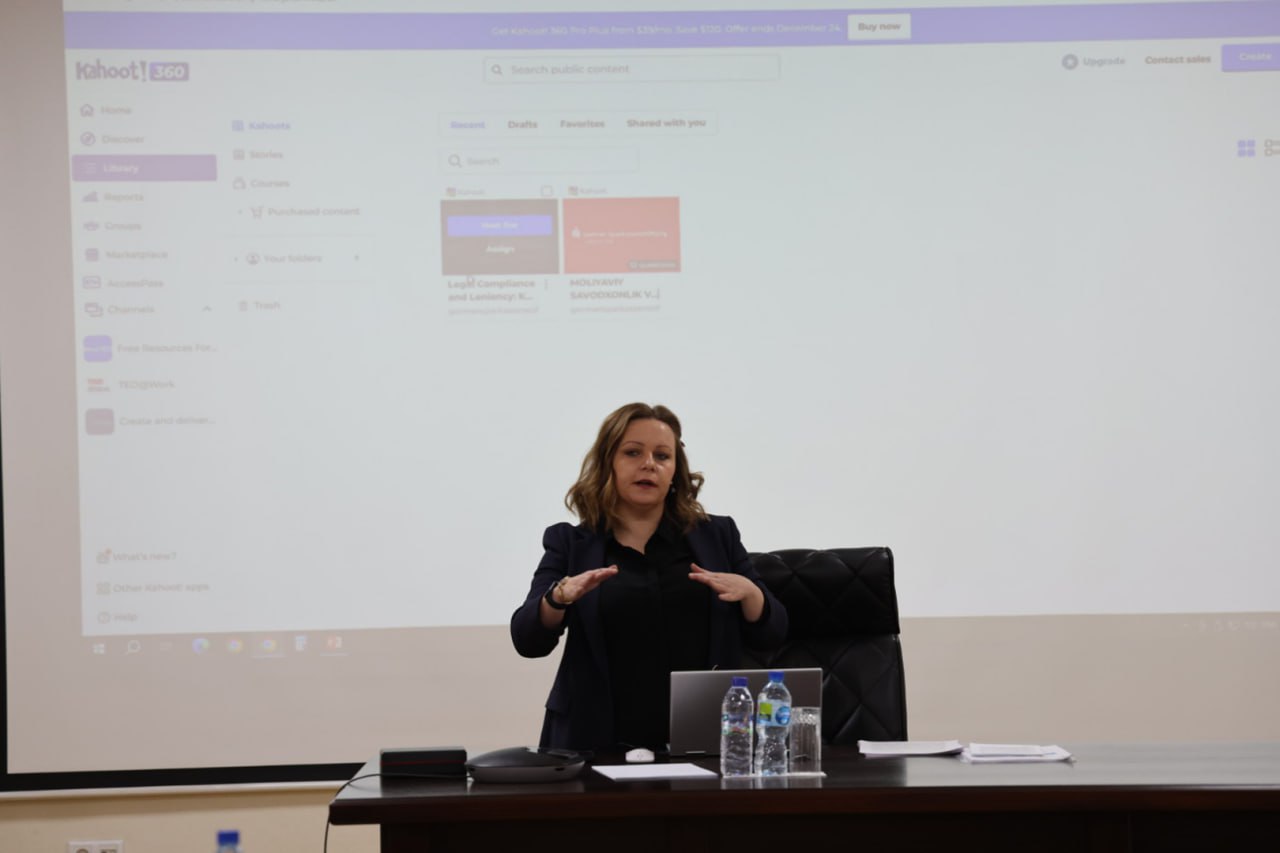
Within the framework of the “Strengthening Institutional Capacity” project implemented in cooperation between the Government of the Republic of Uzbekistan and the World Bank, on December 19, 2025, the third session of the presentation on “Application of Leniency Programmes in Combating Cartels” was held at the Committee for the Development of Competition and Protection of Consumer Rights, delivered by international expert Liya Grauberger.
During the presentation, issues related to developing governance principles for Uzbekistan in the application of leniency programs in combating cartels were discussed. The presentation was conducted in an interactive format, including group work, case study analysis, problem-solving exercises, and discussions.
In the course of the presentation international expert Liya Grauberger provided detailed information on the global practice of Leniency programs. Based on international experience, ideas were exchanged with the participation of the Committee’s specialists on introducing such a program in the context of Uzbekistan. In addition, relevant practical recommendations were provided, and a draft “roadmap” for the implementation of the program was reviewed.
The event was attended by heads of departments and divisions of the Committee’s central office, as well as leading specialists. Within the framework of the presentation, the study of international best practices is of significant practical importance for establishing a consistent and effective policy in Uzbekistan on regulating monopolistic activities, particularly in combating cartel agreements.
This presentation serves to examine modern, transparent, and effective mechanisms for combating cartels, as well as to consider practical actions for implementing approaches in line with international standards, including those of the International Competition Network (ICN) and the Organisation for Economic Cooperation and Development (OECD).
Background: The Leniency Programme is a mechanism that allows participants of cartels to voluntarily disclose illegal agreements in exchange for reduced or waived liability. In many countries, this tool has proven to be one of the most effective instruments in anti-cartel enforcement.